By Emma Carroll
School is already the bane of many student’s existence, but for many of us it is not as bad as we think it is. But imagine if another layer of complications was added on. For Jiang Pham school was more complicated since she had to learn ASL in order to participate in school. Despite this adaptation to school, she has not changed her determination and she continues to work hard everyday.
Jenks has a large diversity of students and provides opportunities for their student population as well. This is no different for the Jenks High School Junior.
Pham grew up in Vietnam, then moved to the United States in 2023. She is deaf, speaks Vietnamese, knows American Sign Language (ASL), is learning piano, loves to paint, and can write in Chinese. Many of her opportunities came from moving continents.
One benefit to moving for Pham was being able to pursue the arts.
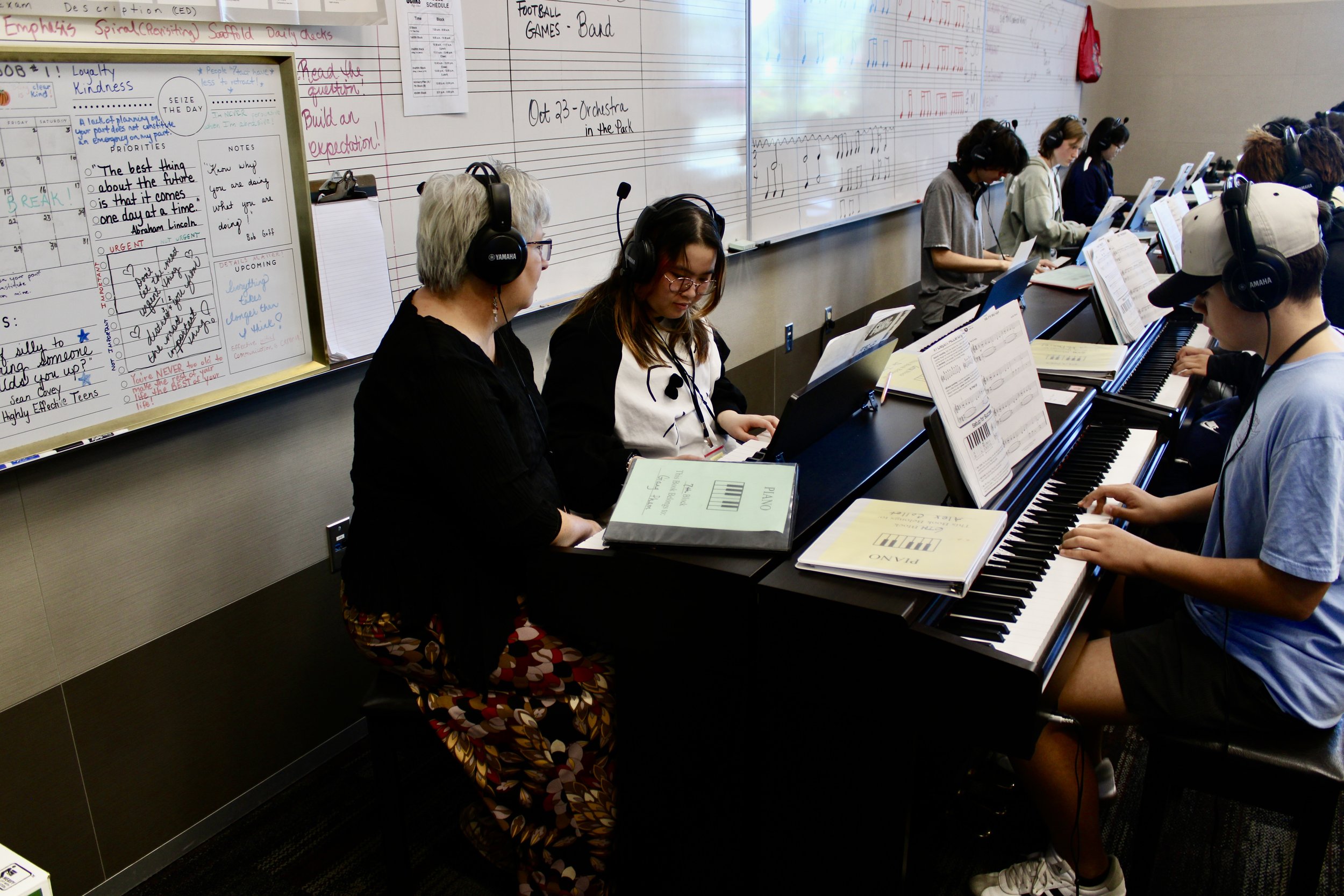
Pham has been able to be taught music at Jenks. She had tinkered with music at home, but taking Group Piano I is her first time being formally instructed in music.
Pham’s face lit up, and she was very enthusiastic when she talked about Group Piano. Group Piano is her favorite class this year. Learning piano has helped Pham learn how to play her favorite genre of music, classical.
“I'm deaf, but when I play the piano, I would say it is hard of hearing,” Said Pham through her interpreter.
The headphones that students wear in Group Piano isolate the sound, so Pham is able to hear her playing. All students wear headphones, so there is no overlap in everyone’s piano playing sound.
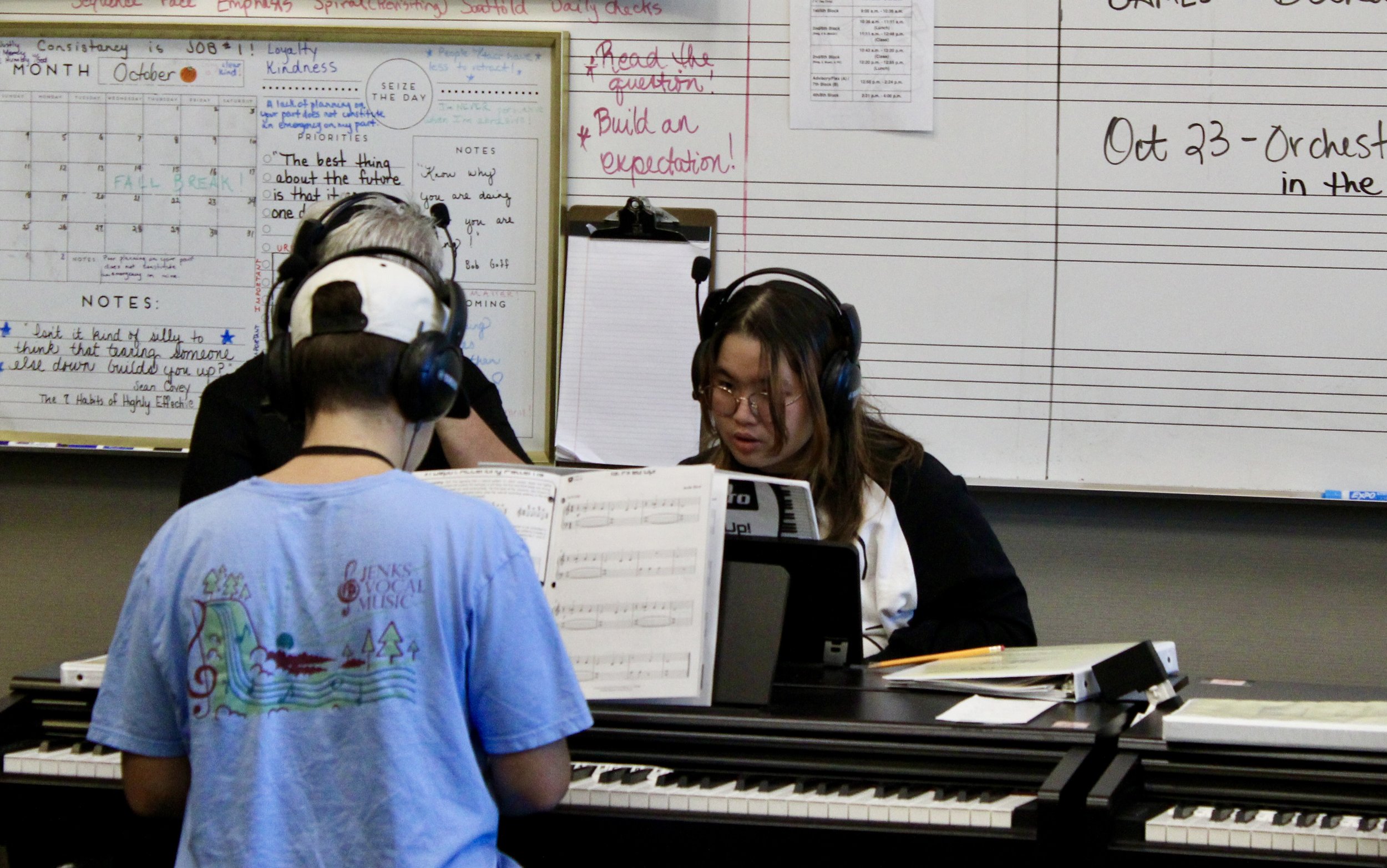
Pham and fellow students are playing with the teacher to practice their music.
Pham also enjoys painting. She favors painting sunsets and landscapes. Moving to the United States has helped her paint more often. However, she was not ready to share her work with everybody.
Another aspect of change can be being in a new environment with new faces.
For Pham, Jenks was a very welcoming place to enter. Though Jenks has been welcoming, there is still a struggle to find connection when you speak a language that not many others know.
“I feel isolated sometimes. Since I can't hear, and I can't speak to the other students,” says Pham.
The small population of ASL signers at Jenks causes this feeling of isolation. This lack of understanding in the general population can make talking to new people hard for Pham. She cannot talk to much of the Jenks population without an interpreter, or by using texting.
And other students are often hesitant to strike up a conversation with Pham. There is an awkwardness when someone does not know ASL or is scared to make a mistake when trying to sign.
It is a new experience to talk to someone by going through an interpreter. Speaking to someone, then waiting for the translation of your words, then their answers to be translated is a very different experience, and one that many students are too apprehensive to try.
One way to try to combat the feeling of isolation is improving the number of ASL signers in the United States. Schools could require, or highly encourage, learning ASL in schools. Similar to the two-year world language credit for Jenks students, a year of ASL could also be a requirement, or replace a year of foreign language.
When asked if ASL should be a more common language taught in schools, Pham said: “Yeah, I mean, it's a language.”
Learning ASL is easier with a good instructor, but it is easy to learn on your own. And through Pham’s adaption to America through learning ASL, she has been able to make more friends and better enjoy being at Jenks.
Learning with an interpreter is one thing Pham had to adjust to.
“It's not really about having an interpreter or not. Like, math is easy for me. But in biology I struggle with the English, so that makes [having an interpreter] important,” said Pham.
The interpreter just helps to make the exchange of information quicker. The interpreter is translating what the teacher says, but also helps make complicated and class-specific words make more sense.
When asked if some things are harder to interpret, Pham’s interpreter said “Not if the student has the right interpreter, the right knowledge of students like their skills.”
Having an experienced interpreter can make the day smoother. And if the interpreter knows the best way of communicating with the student, then it will be better for the student.
Some students use plain ASL to communicate, while others use ASL with a more English-like formatting of their words that is more similar to how a hearing person would talk, according to
Pham’s interpreter.
But change still has hard times, no matter how much you try to make the best of it.
Out of everything in Vietnam, Pham misses her family the most. When she was in Vietnam, her cousin interpreted for her. She was very close with her larger extended family and sister, who stayed in Vietnam, so they hung out daily. When describing their relationship, Pham crossed her fingers to show their closeness.
Pham grew up learning how to speak Vietnamese, and her mother speaks it at home. She learned Vietnamese through exposure at home. All of her family spoke it, so she picked it up before going to school.
But to adapt to the United States, she had to learn ASL. When there is a group of people who know how to sign ASL, it is easier for deaf people to have conversations with others because they can communicate effectively.
The most impactful outcome of moving to the United States for deaf people is access to education. Many countries outside of the United States do not educate their deaf populations. Many countries deny teaching in sign language, or do not teach any sign language at all. And in some countries, finding interpreters is too difficult for most people to want to try.
Although there is an obstacle of adapting to the United States, there are more opportunities available for people once they learn ASL.
Being deaf does not limit most of what Pham can do. Although it makes doing some things hard, there is not a huge limit on what she can pursue. Pham said being deaf makes learning English more difficult, but it does not stop her from learning.
Having interpreters and good teachers helps with pushing past many of the limits she may face. Pham noted that there are deaf lawyers and nurses, so there is no barrier, caused by being deaf, to having a certain occupation.
Jiang Pham is a representation of taking the best out of change. Throughout her life, much has changed, but she has persevered past the hard things and adapted to make the best of her life changes.