By EJ Onley
How often are you interacting with strangers on the internet? Sure, it might start off with a friendly comment on an instagram post from a mutual friend you’ve never met. Then it escalates to messaging in private DMs. This feels weird, but she’s really nice, so you digress. Now she really wants to meet up with you…this is getting odd. Do you politely reject, or meet up with “her”, just to find out “she” was a grown man this entire time?
These kinds of interactions happen more often than one might think, and they usually end in horrific ways. The Demand Project is working to end these frequent exchanges.
According to a report from the National Center for Missing and Exploited Children (NCMEC), in 2025 they received more than 113,500 reports of possible child sex trafficking, a 323% increase from 2024.
A few factors play into this; including the REPORT act passed in 2024, which requires electronic communication service providers to submit reports to the NCMEC when they are aware of violations involving the online sexual exploitation of children.
While this is a reasonable and understandable factor; the increase in financial “sextortion”, which is when someone is pressured to send intimate photos and then blackmailed for money, is also staggering. The inappropriate use of generative AI by abusers to trick children into making contact has also increased dramatically (Our Rescue).

Photo from The Demand Project Instagram page.
These growing factors make the need for these hushed conversations to be vocal increasingly critical.
Whenever you think of something that requires awareness, a range of topics can come to mind. Some include women’s rights, the queer community, and any other minorities. While these topics always need attention, there are others that are too hushed to even talk about in normal day-to-day conversations. The Demand Project in Tulsa is shedding light on possibly one of the most important issues: child trafficking.
The Demand Project is a non-profit organization that was founded in 2013 by Kristin and Jason Weis to eradicate child trafficking, online enticement, child sexual abuse material, and the commerical sexual exploitation of children. This is their mission statement, and they work to fulfill this goal using four main strategies: Prevention through education, Protection by providing legal care, Recovery using Victim Advocate Support teams, and Restoration of survivors through empowerment.
If the problem can be prevented in the first place, that is the greatest thing we can ask for. For their Prevention strategy, they have a team who are equipped with presentations tailored to certain demographics, companies, ages, and even workshops for anyone who wants to attend.
Their AWARE workshop teaches hands-on training and guidance for parents to navigate their children’s social media and internet access in order to protect them.
In their AWAKEN presentation, the main points are how trafficking begins, works, and ends within a community. This also includes how a community can respond to these actions.
And in their last presentation called EMPOWER, they tailored this information to be age-appropriate for kids so they can pick out red flags and the signs of predatory behavior.
Using the power of Protection, they have collaborated with the Tulsa Police Department in order to fight for justice with the help of legal authorities. Having these connections promises compliance with higher authorities, advocacy for clients and residents, and ensures abusers will serve their time as they are deserving of it.
Within their Recovery strategy, they have numerous advocacy and support teams directed to different issues a victim has had or even for the victim’s families. The victim support team includes crisis interventions, private investigators, and any law enforcement officers who can come together in order to legally assist the recovery process for victims. There are similar support teams for families.
The last recovery outlet they have is the Bethany campus clinic and advocacy center on their residential campus. This clinic serves minor medical injuries and can assess damage, while the advocacy center works as a middle-man to conduct investigations and examinations before deciding what legal actions need to be taken.
According to their website, their restoration strategy includes their residential campus called Mount Arukah. This is one of the largest residential campuses in the United States, and it houses girls ages eleven through seventeen who have survived trafficking or exploitation. The campus is at a secret location to protect the girls living there.
The Demand Project also has an extensive volunteer program. One of their main opportunities are the Mount Arukah campus work days; where volunteers landscape, clean, organize, and whatever else they can do to help to keep the place enjoyable to live for the residents. This is managed by their volunteer and office coordinator, Brittni Northup.
Constantly surrounding yourself around these formidable tasks and terrible cases can be draining. Having someone at the office who is there to sustain the energy while keeping everything organized is crucial. Luckily they have Northup on their team to manage the volunteers and events along with making The Demand Project office a rewarding place to be.
“I recruit volunteers within the community,” Northup said when asked to describe her role. “We always have big events throughout the year and we need volunteers to help us run the event.” These events include their annual gala, golf tournaments, booths, and more. “We don’t pay, we don’t have staff that does that, we have all volunteers that do our events.”
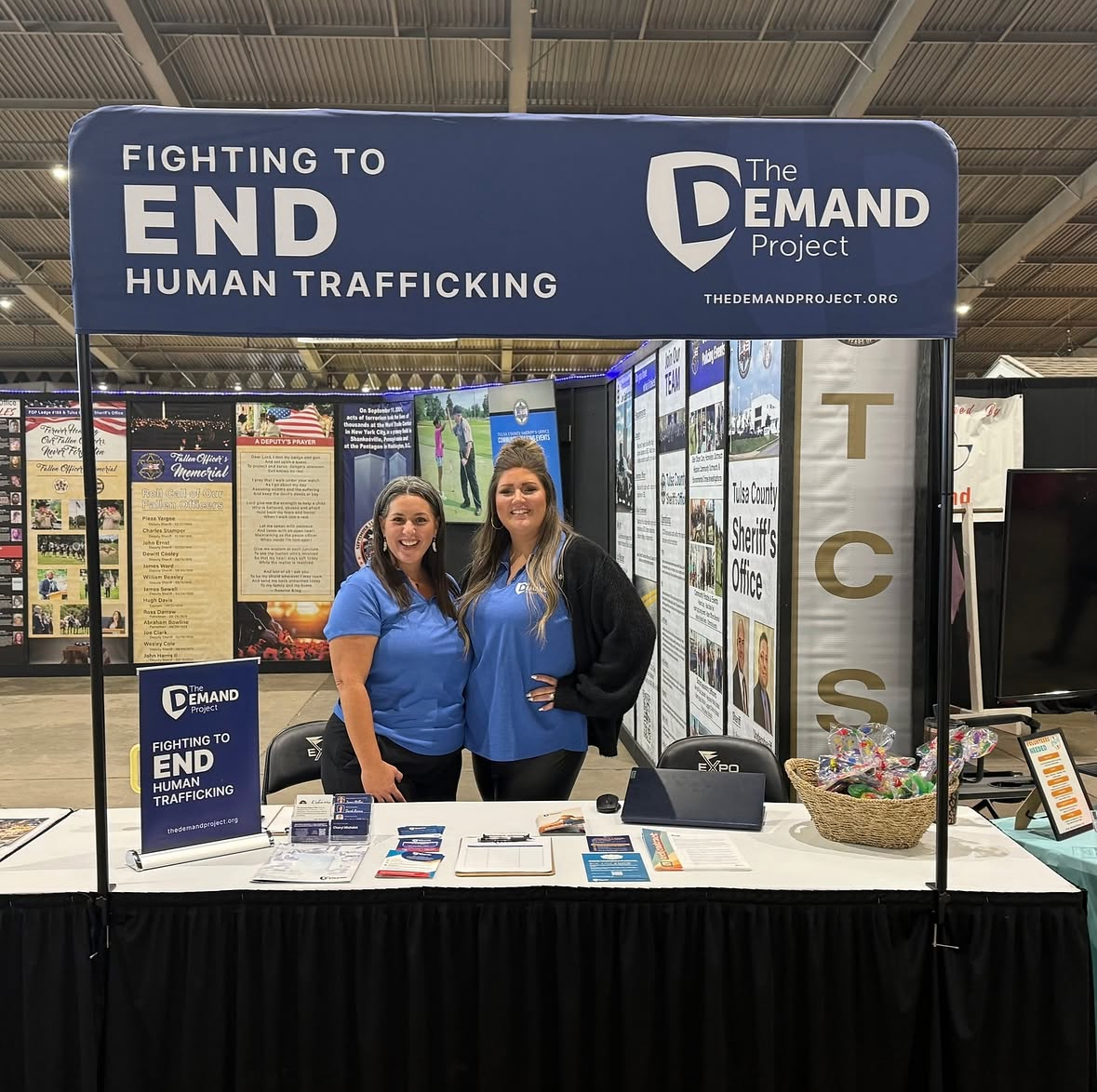
Staff and volunteers working The Demand Project booth at the Tulsa State Fair
“Volunteers [are] a big part of our mission and they are what brings most impact into what we do.” She continued.
Her role as office coordinator is a new implementation, and Northup is excited to take on the challenge. Within this new role, she gets to bridge her responsibilities as volunteer coordinator and invite volunteers to shadow and learn how the organization works and runs, along with making sure the office is lively.
“Having a warm and inviting atmosphere to our office…I can’t wait to do that as well and just help the office run smoothly.” Northup explained. “Just to say the word is hard, right, fighting against human trafficking. It carries a burden and you carry it and sometimes you can drop that burden…and it’s really important.” she continued as we discussed how easy morale can drop in an environment like that.
The Demand Project is lucky to have Northup on their team, because of how dedicated and committed to encouragement she is. Just by walking through the door of their office, anyone can tell how much work she puts into making the place comforting when all they do is discuss the worst imaginable things possible.
If you want to learn more about the ways predators get into contact with children, how to prevent becoming a victim, what you can do to spread awareness, and statistics of how The Demand Project has impacted our community; you can visit their website: thedemandproject.org. If you know anyone who has possibly fallen victim and needs help, you can call their crisis hotline: 833-914-3116.