Iron Man Training For A Week

Photo credit: Logos World
By: Ethan Logan
“You are an Ironman.” These are words that some dream of their entire life. The Ironman is an event, or a journey, that can take many early mornings and late nights. It is the extreme of exercise, the extreme of mental strength, and the extreme of suffering. This event requires intense training in running, cycling, and swimming. It is also considered to be one of the most difficult things a human can do. So, I ask the question, how difficult could it really be?
I decided to find out for myself by spending a week doing the training that an Ironman would have to do. I got the training plan from my friend Dillon Garmin, who was a 2023 Jenks Graduate and a half-ironman finisher. Garmin has been into health and fitness for many years now and plans on competing in the Waco Half Ironman this fall. This race is not only a marathon but also an extreme swim and a difficult bike ride. This event takes the entire day and for most people starts before the sun rises and ends after it sets.
Coming into this training, my thought process was that since I was a varsity track athlete as well as a varsity cross country runner, and I have also biked thousands of miles over the past 6 years, I would have a pretty solid base. As it turns out… I was wrong…
An Ironman has two variants, a half and a full. The full Ironman consists of a 2.4-mile swim, a 26.2-mile run or a full marathon, and a 112-mile bike ride. The half-marathon is 1.2 miles of swimming, a half-marathon, and a 56-mile bike ride. I will be doing about three hours of training for each discipline. This will be spread over a 6-day period, with the rest day being Easter Sunday, also due to Sundays being my typical rest day in the schedule I use in my week-to-week.
The things conflicting with my week are my work being scheduled for Tuesday, Thursday, and Saturday, as well as being a full-time student and having church. The training will also have lifts at least three days this week, and stretching is a must, as well as a decent recovery. I will also track the foods I am eating; diet is very important to high-intensity training, as is water intake.
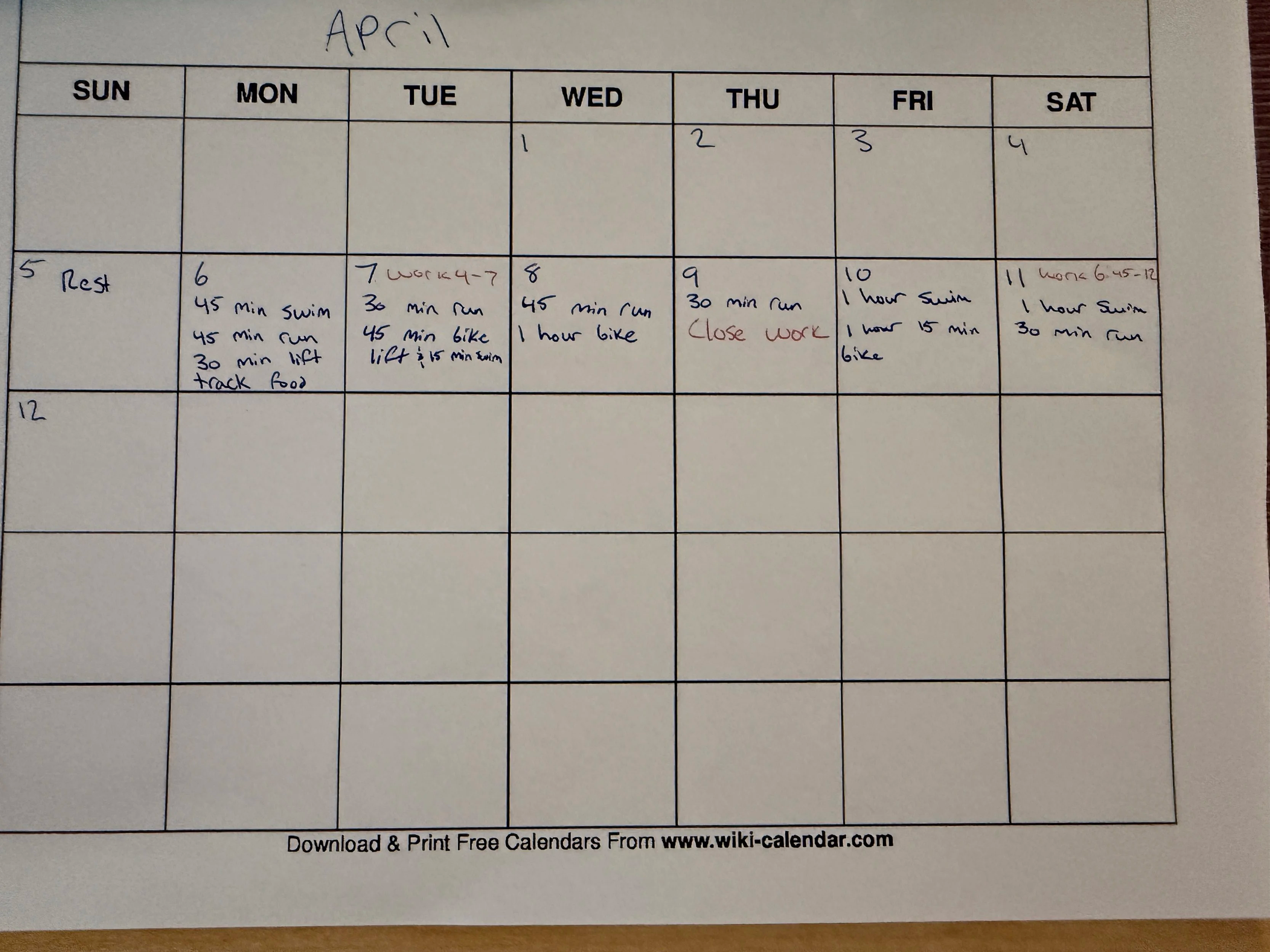
A calendar of my life and how I will train to complete the Ironman to the best of my ability.
Day 1: April 6th 2026
Day one was full of cold water swimming, treadmill running, and a small upper body lift. I kept the lift in the upper body due to the work on my legs I had already done. I didn’t want to tax them more, and in training such as this, you aren’t supposed to work your legs out as intensely. This is due to recovery and the need for fresh legs in the training.
Going into this training, I honestly believed the most difficult part would be running; I was very wrong. The swimming took way more out of me than I could have imagined. The water was painful and freezing, and then the cardio was extreme.
I have never been that good of a swimmer; my mother even made me take swim lessons when I was 12 years old. I feel like I just sink. It also didn’t help that the water made my body shake and feel numb; it sped up my breathing. It took a while for me to even get 45 minutes. From running and swimming, as well as failure to recover properly, I had lots of tightness in my hips and in my quads that needed to be stretched out.
One aspect that I believe is overlooked when training in a way such as this is food and water intake. There are lots of things that are important to get lots of when eating and doing extreme exercise, such as good sodium intake, carbs, and protein. I also took a supplement designed to help muscle saturation, recovery, and brain function called creatine. Creatine is also in red meat, but allows your muscles to store more water to allow you to exert more and for longer periods.
The lift was exhausting, especially since it was being done so late at night. The lift was very late at night due to my having to do all the training beforehand, and me starting later in the afternoon than I should’ve. Keeping a schedule and operating within one was by far the most difficult challenge I faced with this challenge. Purely the amount of time the training took, and also how much I had already gone on, was very difficult.
Day: 2 April 7th 2026
Yesterday was the 2nd time I had run in 5 months. It made me sore and was a little exhausting, not to mention I almost never swim, so it blitzed my body too.
Outside running is significantly better than treadmill or indoor running. There is nothing in this world that I dislike more than running on a treadmill. Plus, the treadmill isn’t always comfortable due to the people around and the difficulty breathing, so being outside was literally a breath of fresh air. It was closer to the end of the day, and it was beautiful. I ran a loop throughout a neighborhood, and it was very relaxing. Running outside also caused me to run a bit faster.
One thing that is difficult about running too is the strain it puts on your knees and lower back at times. Due to my inactivity with running, I was feeling the pain of not training consistently. But I ate way more, drank way more, and slept more this day due to the soreness and exhaustion. Anyway, though it still caused exhaustion, the exhaustion just got worse and worse throughout day two.
Day 3: April 8th 2026
I ran out of time on the bike and the run tonight, but I was able to pick it up later in the week. I started my run but had to run to a meeting for Jenks’ baccalaureate. Then the biking started very late, so I had a very hard time getting the time I needed, let alone the time I got. The runs have honestly been really nice, though. Running was something I have done for a very long time, and it makes me very happy to be doing it again.
Eating has been a struggle for me, too; it becomes difficult to eat clean and hit certain amounts of calories. Foods that I have been eating aren’t always that dense in calories, but are still important, such as oranges. Oranges have important nutrients, but I cannot get enough of them for calories.
One thing that was apparent on day three was that the soreness had weakened a bit. I felt less pain in my hips, quads, and back, so I felt a little better and more energized. Throughout the week, this honestly continued; it almost got a bit easier, too.
Day 4: April 9th 2026
My knees felt worse today than on any other day. All the running on the concrete caught up to me. Today was also one of the most exhausting days I have had at school in a very long time. My joints were more sore than my muscles, too.
I think one of the most important things for high-intensity training is rest and recovery. Also, that is dependent on who the person is. High-intensity training looks very different for different people. But make sure you eat, stretch, ice, sleep, drink water, and get electrolytes.
Those things help prevent dips in energy, pains, cramps, injury, and soreness. I prepared the best I could, but going from not nearly enough training to the extreme of training will do that. Knowing how to build up to a healthy level of training is important, too. If you jump too quickly into high-level workouts, it is a great way to get injured, too. It becomes really obvious when people begin to have bad joint pains and not as much muscle pain. Another key to avoiding injury and having the best training is getting proper equipment that is good for you and your training. For example, running shoes had different widths, tilts, stacks, and ankle supports. There are other levels, but these are some. It depends on your feet and your training; also, good socks are important to not blister. Cycling, wearing cycling shorts, a helmet, and sunglasses are needed. Swimming goggles and wax or a swim cap can help to avoid swimmers' ears. Swimmers' ears are awful.
One thought that has been in my head this entire time is, have I been eating enough? I think that my being conscious of it makes me eat less, too. But, despite this, we will prevail.
Day 5: April 10th 2026
Thursdays can be difficult as is in my life, but especially when I have to run afterward. I know what I do throughout the day isn’t the most difficult, but it takes time. And, doing something or multiple things throughout the day for 14 hours is exhausting. I come home with my ankle and knees tight and sore from standing for the last 6.5 hours.
But we get it done anyway because this is what I signed up for. Plus, a major part of training for this extreme is sacrifice. I believe learning how to sacrifice and do the difficult things in life is a skill that everyone should attempt to learn. There is nothing that will benefit you more than knowing how to work when it is difficult and when it is inconvenient. It can even build a resilience that you cannot get in other places. Today I had to sacrifice my comfort and get out of bed early, I sacrificed going out as much to spend time training, and I sacrificed sleep to sometimes get a little more done. Those are the things that go unnoticed about Iron Men and what their training calls them.
Today gave me some confidence because I ate way more than I normally do. Today was the first day I got enough calories and plenty of other proteins, carbs, and more. Today I was a little more sore; I spent lots of time working and on my feet, so the day caught up with me just a bit. But, overall, I had an amazingly productive day.
Day 6: April 11th 2026
The worst part of this day is how it started.
The exercise was exhausting, and the swimming was always brutal, but at least I was inside this time. Sleeping was difficult due to my schedule being very inconsistent, and also just feeling exhausted the entire time. Waking up, I felt like I was dying, and going to bed always felt later than the day before that. Part of what made waking up difficult was the heaviness in my body. It just made me feel more and more tired each day. I tried to fuel myself any way I could, but it didn’t always work. My workout was some bodyweight exercises such as push-ups, sit-ups, and pull-ups, just to be inclined to do more. The swimming was still awful, the cardio needed to tread water for long periods of time is unlike any exercise I have done. The strength needed is something I also lack due to the density of water.
The biking was a blast, I love riding my bike because it is the one moment where I can just think. Without it, I don’t know what I would do. So, an hour and some change was the easiest thing I did all week. This also allowed me to end this challenging week on a great note.
In the end, this was difficult. There isn’t another way around it; it hurt, it took time, and it took discipline. I can say this, it is possible, but I have no idea how. The most difficult part was assigning time to everything. But what I can say is I did it, but it took a lot. So hats off to those who go above and beyond and complete this competition.